Glamour Magic by Deborah Castellano
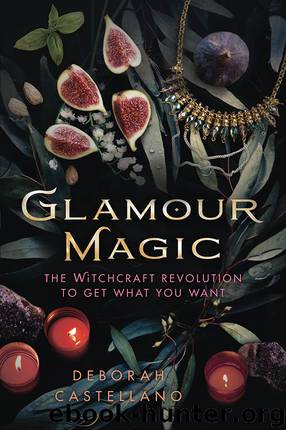
Author:Deborah Castellano
Language: eng
Format: epub, mobi
Tags: magical fashion, magickal fashion, glamor magic, glamor magick, glamour magick, debora castellano, debra castellano, deborah castellano, spells, spell book, magic, pagan, paganism, witchcraft
Publisher: Llewellyn Worldwide, LTD.
Published: 2017-06-23T04:00:00+00:00
Lessons from Joan
If an illiterate, fifteen-year-old medieval farm girl without means or familial influence could make her way to the royal court and get an unlikely candidate crowned as king using only her natural glamour and the strength of her conviction, what Great Work couldn’t you accomplish? Joan may not have had strong alliances with powerful women when she started her quest, but once her glamour helped her gain their support, she was unstoppable.
Empathy Is Not Optional in Glamour
When working with others, empathy is very important to accomplishing your Great Work, but it is not everything. You need both glamour and empathy to be an unstoppable force. Put simply, empathy is what you do, and glamour is what you are. In Hinduism, the god Shiva is being and the goddess Parvati is doing. If you are too much of being, while you may achieve enlightenment, you may also amble aimlessly through the cremation grounds smoking pot for an eternity. If you are too much of doing, you may get as much done as Martha Stewart but you may get caught up in laundry instead of enlightenment. Shiva and Parvati are married, symbolizing the unity of male (passive) energy and female (active) energy of the universe. When they are fused together, they form the deity Ardhanarishvara, who is both fierce and gentle as well as loving and destructive—all of the universe’s possibilities in one balanced being.
Empathy is the starting place for the active part of glamour. Essentially, empathy is when you catch what someone else is feeling and you feel it yourself. For most people this is an automatic reaction. A loved one feels sad, so you feel sad in return. At this level, empathy is called affective empathy. If you can understand what someone is going through (loss of a parent, job loss, divorce, et cetera) because you’ve experienced it yourself, you are engaging in experiential empathy. Cognitive empathy is when you find how the other person feels about a situation by actively engaging with them through listening and asking questions. Finally, imaginative empathy is when you imagine yourself as the other person and figure out how you would react in their situation.
If empathy is not a skill that comes easily to you, don’t despair. While it is important, it’s not an exact science and has its own limitations. You won’t always imagine how the other person is feeling correctly. Something that makes you feel angry if it happened to you may make the other person feel scared or sad. Empathy alone is unlikely to inspire you to help the other person. While you may feel happy, sad, or another emotion in that moment with the other party, you may then go about your day as you usually would without doing anything to help the other party. Even if you don’t feel empathy for another person’s situation, you may feel inclined to help her because you feel it’s the right thing to do. There’s also generally an unconscious human bias
Download
This site does not store any files on its server. We only index and link to content provided by other sites. Please contact the content providers to delete copyright contents if any and email us, we'll remove relevant links or contents immediately.
Becoming Supernatural by Dr. Joe Dispenza(8217)
Crystal Healing for Women by Mariah K. Lyons(7931)
The Witchcraft of Salem Village by Shirley Jackson(7274)
Inner Engineering: A Yogi's Guide to Joy by Sadhguru(6794)
The Four Agreements by Don Miguel Ruiz(6765)
The Power of Now: A Guide to Spiritual Enlightenment by Eckhart Tolle(5781)
Secrets of Antigravity Propulsion: Tesla, UFOs, and Classified Aerospace Technology by Ph.D. Paul A. Laviolette(5371)
The Wisdom of Sundays by Oprah Winfrey(5161)
Room 212 by Kate Stewart(5121)
Pale Blue Dot by Carl Sagan(5008)
Fear by Osho(4740)
The David Icke Guide to the Global Conspiracy (and how to end it) by David Icke(4719)
Animal Frequency by Melissa Alvarez(4472)
Rising Strong by Brene Brown(4459)
How to Change Your Mind by Michael Pollan(4356)
Sigil Witchery by Laura Tempest Zakroff(4246)
Man and His Symbols by Carl Gustav Jung(4135)
The Art of Happiness by The Dalai Lama(4130)
Real Magic by Dean Radin PhD(4129)
